See
Majesty
见陛下
Jiàn bìxià
陛下を見る
Heika o miru
ps93
The sun begins to rise.
Rays of light shoot through the sky.
The crown of heaven shines with light.
The planet turns to the sun for sight.
The sky puts on royal robes.
The land reveals tapestry for half the globe.
The world is a continuity for interaction.
Providence produces satisfaction.
The ground for movement can't be moved.
Beatitude is proven, yet remains to be proved.
The Lord is king. Let the majesty bring
executive authority to the collegial ring.
If the power were granted to break out of your cells
you would see the plight that false unity foretells.
Imagination stalls as the door to sensation closes
on the child within who dares to propose
change for the better as something to be shown
as the shape you dread beyond the past as the only known.
Are you bowed down in heart?
Do you hear the clashing discords that start
to mend the din of life between the beats of the quartered part?
Then come away to the peaceful wood.
Bathe your soul in the silence of solitude as good.
Listen to the strains above, around and within you.
They bubble up in rippling notes to swell as song sung in tones so true.
Now let your soul run the gamut of the scale for music
until it touches the tonic chord you can afford as a rubric.
The earth is filled with heavenly accord.
The awe of appreciation will be stored to be adored.
You will never feel bored.
Those who feel the certainty of doubt
build knowledge with faith to figure things out.
Republic presents the written administrative case
for the divine self recalling the absolute in time and space.
Kingdom represents the verbal case in the same race.
Constitutional monarchy is the best form for conservative pace.
Religion is bound to common law.
Alliance through allegiance seeks to correct flaw.
The path to citizenship is civil ground for religious awe.
Assembly, protest and petition are allowed by law
so long as rebellion or subversion are corrected as flawed.
When gold and gems adorn the iron plow
envy will bow
to the peaceful art of living now.
A riddle or the cricket's chirp
is a fit reply to those who would usurp.
The majesty of the loyal leader
is respect that is shown for the rock known as Peter.
Apostolic reverence for the love of God
is the established path on which we trod.
Sovereignty protects the church.
The defense of freedom has a noble worth.
The reformed reform and the counter-reformation
indulged the overthrow of the sovereign nation.
National security was made a global race.
Precipitation for war was an international disgrace.
Mercantilism with slavery was the largest indulgence.
Official convenience misdirected sober thought with abundance.
The colonial exploitation of natural resources
overrode concern for free market forces.
The protection that was supposed to be used for trade as trait
became an obsession with weapons for those who would not 'negotiate.'
The bird of wonder died as the maiden phoenix.
From the ashes of her admiration rose another genius.
The free market is the wealth of nations.
The invisible hand guides the acts for each in accord with station.
Constitutional cognition
is thought for the recognition
of the reconstruction of classical volition.
Wherever the bright sun of heaven will shine
greatness will be honored to look divine.
There is a unity that exists for all.
Regularity is an expression of this thrawl.
Chance is irregularity in nature's call to crawl.
The Spirit is energy with identity behind sensation's wall.
One like a human being
came down in darkness in the vision I was seeing
of this Ancient Royal who was preceding
to give instruction in succeeding
with believing in interceding.
Even those who don't believe the instruction in function
will see the value of defense against destruction
as the gauge for action in the unction for construction.
Are you the King of convention for the protection
of our production?
Consent to the promise for this place
revives skill in decreasing foolishness in the human race.
The first in the sequence of agreement with the promise
of protection for productivity in production was an honest doubting Thomas.
The sweet smell of incense speaks of energy by consumption
as an aromatic unguent for our function with substance.
The majesty of power is economic
in the mountain of experience for the polyphonic tonic.
The waters of ancestral beauty
establish the enjoyment of duty.
The waters have lifted up their voice.
Fluidity is a condition within the bounds for choice.
The Author of unity is more mighty than the breakers on the shore.
The common task is to find the will that will adorn what we adore.
Productive value is the market share
for those who will to serve the public that's there.
Like a mountain cedar with branches that reach out to the nations,
the shade for trade will produce thirst for language in foreign stations.
Our children's children will be like the plains
that yield benefit from the translation of gains.
ps93
Dominus regnavit
1 The Lord is King;
he has put on splendid apparel;
the Lord has put on his apparel
and girded himself with strength.
2 He has made the whole world so sure
that it cannot be moved;
3 Ever since the world began, your throne has been established;
you are from everlasting.
4 The waters have lifted up, O Lord,
the waters have lifted up their voice;
the waters have lifted up their pounding waves.
5 Mightier than the sound of many waters,
mightier than the breakers of the sea,
mightier is the Lord who dwells on high.
6 Your testimonies are very sure,
and holiness adorns your house, O Lord,
for ever and for evermore.
Dan.7:13
As I watched in the night visions,
I saw one like a human being
coming with the clouds of heaven.
He came to the Ancient One
and was presented before him.
Rev.1:7
Look! He is coming with the clouds;
every eye will see him,
even those who pierced him;
and on his account all the tribes of the earth will wail.
So it is to be. Amen.
John 18:33-34
Then Pilate entered the headquarters again, summoned Jesus, and asked him, ‘Are you the King of the Jews?’ Jesus answered, ‘Do you ask this on your own, or did others tell you about me?’
Improve

Baruch Spinoza 11.24.1632 Amsterdam, Dutch Republic
Simplified 霸鲁克苏皮诺所以啊
Traditional 霸魯克蘇皮諾所以啊
霸 Ba dominate 戦い tatakai fight Ba ば バ Ba 바 bar
鲁 lu crass 魯 ro foolish ru る ル lug 룩 look
克 ke gram 克 katsu skillfully ku く ク Seu 스 switch
苏 Su revive 蘇 so revive Su す ス pi 피 blood
皮 pi skin 皮 kawa skin pi ぴ ピ no 노 furnace
诺 nuo promise 諾 daku consent no の ノ ja 자 character
所 suo place 所 tokoro place za ざ ザ
以 yi for 以 ih beyond
啊 a ah 啊
Amsterdam is the capital for the Netherlands. Amsterdam's name derives from Amstelredamme. The city's origin was built around a dam for the river Amstel.
The city is located in the western Netherlands in the province of North Holland. It is connected to the North Sea through the long North Sea Canal. The canal is west of the city. A set of locks to the east makes passage by water to the IJmeer possible. The water ways make the location accessible to global trade.
The Athenaeum Illustre or Illustrious School was formed in Amsterdam in 1632. The school was sponsored by the city. It was organized after the beeldenstorm in the old Agnieten chapel. The beeldenstorm was an iconoclastic rebellion against religious images.
Church art and many forms of fittings were destroyed in mob action as part of a 'classical' opposition to monotheistic religion in government. The reformed Protestants were against Roman Catholic and Spanish rule of the Netherlands.
The Athenaeum Illustre is regarded as the predecessor to the University of Amsterdam. It wasn't lawfully recognized for diplomas until 1815.
Amsterdam became one of the most important ports in the world during the Dutch Golden Age. The Dutch Golden Age was a period in the history of the Netherlands that spanned the 17th century. Dutch art and science were among the most acclaimed in the world with the trade along sea routes. The military protected the trade.
Benedito de Espinoza was born on 24 November 1632 in the Jodenbuurt in Amsterdam, Netherlands. The Jodenbuurt was a Jewish neighborhood. He was the second son of Miguel de Espinoza, a successful, although not wealthy, Portuguese Sephardic Jewish merchant in the city.
His mother, Ana Débora, was Miguel's second wife. She died when Baruch was only six years old.
Spinoza's mother tongue was Portuguese. He also knew Hebrew, Spanish, Dutch, and perhaps French. He learned Latin only late in his youth.
Spinoza's father, Miguel, died in 1654 when Spinoza was 21. He duly recited Kaddish, the Jewish prayer of mourning, for eleven months as required by Jewish law. When his sister Rebekah disputed his inheritance, he took her to court to establish his claim. He won his case, but then renounced his claim in her favor.
He became acquainted with an anti-clerical sect of Remonstrants with tendencies towards rationalism during this period. This group was called the Collegiants. He also associated with the Mennonites who had existed for a century but were close to the Remonstrants.
Many of his friends belonged to dissident Christian groups which met regularly to discuss the bible and religion. The groups typically rejected the authority of established churches as well as traditional dogmas.
Spinoza's philosophy held an attraction for late 18th-century Europeans. It provided an alternative to materialism, atheism and deism. He provided a conceptual frame for the Enlightenment philosophy as it related to the government of law.
Three of Spinoza's ideas held a strong appeal.
The unity of all exists.
Regularity is a function of the unity.
Energy expresses the Spirit for the identity of the unity.
Both Descartes and Spinoza lived in the Dutch Republic (1581-1795). Descartes (31 March 1596 – 11 February 1650) preceded Spinoza (24 November 1632 – 21 February 1677) as a contemporary.
The current Kingdom of the Netherlands is a constitutional monarchy. Spinoza had proposed this form of government as best with his Tractatus Theologico-Politicus.
Constitutional monarchy has the potential to exceed a constitutional republic in democracy with conservative economics by virtue of the dynastic succession.
The resurrection of republic as a form of government required the application of reason to define the purpose of government, commerce and society.
Rosseau's ideas of education are limited according to contemporary standards, but his social contract provided the essential factor for the determination of law. The government is obliged to serve the people who pay for functional operations.
Spinoza was a sephardic Jew. His family moved to the Dutch Republic to escape persecution from the Inquisition in Spain. He was a rational philosopher. He was one of the most important and radical thinkers of the early modern period.
His thought combines a commitment to a number of Cartesian metaphysical and epistemological principles with elements from Euclidean geometry, ancient Stoicism, Hobbes and medieval Jewish rationalism. The respective principles are grafted into an original system.
His naturalistic view of God, the world, the human being and knowledge served to ground a moral philosophy centered on the control of the passions. Self-control was the key to finding happiness with virtue.
Virtue was to lay the foundations for democratic political thought. Pretension regarding the dogmatic interpretation of Scripture and sectarian religion were criticized in order to reject that which was wrong about political or social policy in the past.
Spinoza was issued the harshest writ of herem or excommunication ever pronounced by the Sephardic community of Amsterdam on July 27, 1656. It was never rescinded. We do not know for certain what Spinoza’s “monstrous deeds” and “abominable heresies” were alleged to have been. An educated guess comes quite easily.
He was expressing those ideas that would soon appear in his philosophical treatises. He denies the immortality of the soul; rejects the notion of deity as having an existence completely distinct from creation and claims that the Law was not specifically given to the Jews nor was it binding in every aspect of the ancient expression. He was exiled from the religious community. He was not subjected to torture or the death penalty for whatever the perceived offense was.
It has since been shown that the Hebrew texts contain elements from the ancient codes of law in the Middle East. The law against murder as expressed in the second commandment was in the code of Ur Nammu. The death penalty was used to punish infraction, but the penalty was not limited to murder at the time.
The punishment for murder with a penalty less than death was expressed in the story of Cain and Abel. The code of Hammurabi punished killing with a fine if the killer said that he killed without malice.
The code was Babylonian. It had been adopted from the Sumerians. The punishment was an ancient form of an indulgence. It allowed for murder as a form of political ascension. Competition was eliminated by violent aggression. It wasn't a civil form for leadership in organization.
Spinoza was banished from his community. He was content to have an excuse to depart. His community and religious commitment were gone by this point. He was interested in writing something modern. He wanted it to have an impact on the European world. He left Amsterdam altogether within a few years.
He began writing in 1661. He was living in Rijnsburg, not far from Leiden. He worked on the “Treatise on the Emendation of the Intellect,” an essay on philosophical method. He also wrote the “Short Treatise on God, Man and His Well-Being.” This was an initial but aborted effort to lay out his metaphysical, epistemological and moral views.
His critical exposition of Descartes’s “Principles of Philosophy” was the only work he published under his own name in his lifetime. It was completed in 1663 after he had moved to Voorburg outside the Hague.
He was also working on what would eventually be called “The Ethics” by this time. This was his philosophical masterpiece. When he saw the principles of toleration in Holland being threatened by reactionary forces however, he put it aside to complete his “scandalous” “Theological-Political Treatise.” This was published anonymously and to great alarm in 1670. One overwrought critic called it “a book forged in hell by the devil himself”.
When Spinoza died in 1677, he was still at work on his “Political Treatise’” This was soon published by his friends along with his other unpublished writing including a “Compendium to Hebrew Grammar.”
“The Ethics” was written in the form of a geometric proof. It was modeled on Euclid’s “Elements.” The basic definition for a point is a location. It has no length or extension. It is used as a metaphor for the “self” as the “essence of existence” in “The Ethics.” A line is a continuity of points. It has length. It extends in space. It is comparable to what Descartes identifies as thought.
The proof is written to prove the existence of goodness as the cause for ethics. God is posited as the absolute infinite. Divine existence is the essence of substance. This substance permeates existence. Infinity is used to contrast the finite.
The finite contains the substance of matter. Substance has attributes. The extension of substance however does not pertain to the essence of deity. This denies the notion of Platonic ideals with respect for destructiveness as an extension of the divine will through the elements.
Will is a particular mode of thought. It is a necessary cause. It is the search to draw function from purpose. Knowledge is the awareness of the cause of change. Freedom is the image. Creativity is the likeness. Each person is the agent of personal will. Ethics is the discovery of functional benefit. It does not conflict with the law of causation.
Spinoza's influence found its way to the US through the French philosophy that agreed with his proposal for Constitutional law. The Constitution was largely composed by James Madison. The Bill of Rights was added to show the ability to amend law for people.
Education in the country was not necessarily aimed toward this purpose. Institutions for higher education were organized to promote interest in idealism among the general population.
Only a few seminaries like Andover or Union offered post-graduate education before 1860. Yale awarded the first Ph.D. degree in 1861. Pennsylvania (1870); Harvard (1872); Johns Hopkins (1878); Princeton (1879) and Cornell (1880) followed.
Johns Hopkins was founded for graduate students in 1876. The first true professors of philosophy holding an American PhD were G. Stanley Hall (Harvard 1878) and Josiah Royce (Johns Hopkins 1878). Both of them received their education in Germany.
Philosophers were scattered across the landscape during the Reconstruction era and the beginnings of the Gilded age. They were found only at the best colleges. Most of those granted the title of Professor of Philosophy were presidents of their colleges.
Not all of them had doctorates. Some held a bachelors of divinity degree. They taught the senior classes in denominational theology and religious ethics. G. Stanley Hall reported that perhaps 40 of these professors actually had serious philosophical training in "Philosophy in the United States" in 1879.
Much of the important philosophical creativity was still generated by theologians. Those who responded to the issues of workers' rights or to the challenge of evolution were especially instrumental in shifting the focus from theology to political and social policy.
Social Science provided another fertile source for philosophical thinking. Thought was valued in the identification of social problems for cure.
Hundreds of scholars attended German universities during 1870-1900 for their prestige and lower cost. That trend would reverse by 1900. American universities would come to swell with graduate students.
The Calvinist tradition continued at Princeton, Yale, Union and innumerable smaller colleges with special attention to the history of religion in the US. Unitarian Harvard, Liberal Andover, Humanist Chicago and Personalist Boston had strong counter-balancing theological movements. Historicism, biblical hermeneutics and evolution became acceptable.
American theology was also re-energized by the new holiness churches. The Third Great Awakening would seek to make an impact on the 1880’s and 90’s. Everyone was called to take notice of the Social Gospel and Christian Progressive movements that demanded new religious activism. The focus was on the consequences of industrialism and immigration.
Evolution was accepted before Darwin even by clergy, but only as a theory of divine providence aiming at the eventual productivity of mankind. Only a few daring thinkers embraced the theory of natural selection by random mutation after the publication of Darwin's Origin of the Species, (1859). Some applied evolution to metaphysics and cosmology. Others applied evolution to the human mind.
The philosophical category of "mental science" popularized by the Scottish realists was the original home to those who called themselves psychologists. Experiments for nerve and brain physiology trained subjects to track mental processes.
Some were eager to apply the new biological theories of evolution. The Scottish realist James McCosh and pragmatists Charles Peirce and William James belong to the early evolutionary philosophers.
The contrast between evolution and fundamentalism could not have been sharper than at Princeton in the 1860’s and 70’s. McCosh taught an evolutionary philosophy and Charles Hodge taught anti-Darwinian fundamentalism.
Many universities harbored such conflict during this period. The relations between philosophy and psychology were similarly contentious. Physiological and experimental methods challenged traditional introspection into the mind's operations.
Transcendentalism was evolving into Pragmatism's commitment to the notion that an idea is true if it a makes a practical difference in the life of the person who thinks it. Truth is not some abstract certainty that exists outside of human experience. It is a manifestation of practical reason.
The Cambridge Metaphysical club had its origins in James's 1868 proposal to Oliver Wendell Holmes Jr. (1841-1935). He proposed that they establish 'a philosophical society to have regular meetings and discuss none but the very tallest and broadest questions' (Kuklick 1974: 47).
The club was underway by 1871. It centered around six men with Harvard degrees: James, Holmes, Charles Peirce, Chauncey Wright, Nicholas St. John Green and Joseph Bangs Warner.
Green, a Boston attorney, introduced the thought of the British psychologist and philosopher Alexander Bain (1818-1903) to the group. Bain’s definition of belief as that 'upon which a man is prepared to act' was highlighted.
Wright was a mathematician employed by the Nautical Almanac as a 'calculator.' He was also an occasional lecturer in psychology and physics at Harvard. He applied Darwin's evolutionary theory to the development of consciousness in such publications as the “Evolution of Consciousness” (1873).
He maintained that consciousness comes about not from anything new but from the use of an old capacity. The forming of images in a new way shapes the structure of thought.
Josiah Royce was to take a position contrary to William James at Harvard. Royce would become the major advocate for American idealism. American idealism was a preservation of the connection to the Constitutional cognition proposed by Spinoza.
Thought
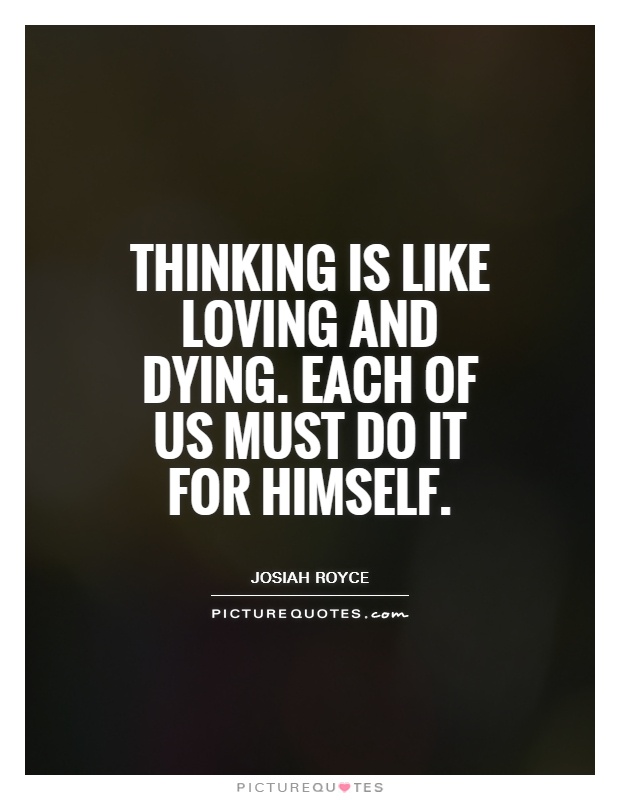
Josiah Royce 11.20.1855 Grass Valley, California
S. 约西亚罗伊斯
T. 約西亞羅伊斯
约 Yue agreement 約 yaku promise Jiyo じょ ジョ Jo 조 article
西 xi the west 西 nishi west, Spain shi し シ si 시 city
亚 ya Asian 亞 a rank, sub- a あ ア a 아 ah
罗 luo catch 羅 ra lightweight fabric Roi ろい ロイ Lo 로 in
伊 yi he, she 伊 i first in sequence su す ス i 이 this
斯 si this 斯 koko here seu 스 switch
The city of Grass Valley is located at roughly 2,500 feet (760 m) above sea level in the western foothills of the Sierra Nevada mountain range. It is 57 miles north by northeast (92 km) by car from the state capitol in Sacramento. It is 143 miles (230 km) northeast of San Francisco.
The settlement was started during the California Gold Rush. A post office was established in 1851.
There was a population of 3500 in 1855. The number of women in town had increased from two in 1852, but not by much. The population was mixed due to the international nature of the gold rush, but the institutions and values of the United States predominated.
There were reports of fights and other hostilities. Tensions between the Americans and the foreign born were in evidence.
It was the location of the Empire Mine and North Star Mine, two of the richest mines in California. Many of those who settled in Grass Valley were tin miners from Cornwall, England.
They were attracted to the California gold fields because the same skills needed for deep tin mining were needed for hardrock gold mining. Many of them specialized in pumping the water out of very deep mining shafts.
A five member Board of Trustees was elected in March 1855. They passed passed sixteen municipal ordinances. The Marshal made four arrests on his first day on the job. One was for a fight. One was for riding his horse too fast. Two women were cited for wearing male attire in public.
The Board passed an ordinance requiring every occupant of every house to construct a container holding at least fifty gallons of water. Four fire buckets were to be available for each story. This ordinance was never enforced. There were tragic consequences on September 13, 1855.
The destruction was enormous. More than three hundred buildings were destroyed in an area covering thirty acres. Only two structures escaped in the downtown business district. Every hotel and boarding house was ruined. Residents lost their savings and important documents to the fire.
Josiah Royce was born in Grass Valley, California, on November 20, 1855. He was the son of Josiah and Sarah Eleanor (Bayliss) Royce. Their families were recent English emigrants who sought their fortune in the westward movement of the American pioneers in 1849.
Josiah received his B.A. from the University of California in 1875. The university moved from Oakland to Berkeley during his matriculation. He later accepted an instructorship teaching English composition, literature and rhetoric there.
He studied with Joseph LeConte, Professor of Geology and Natural History while he gave instruction in English. LeConte was a prominent spokesperson for the compatibility between evolution and religion. The argument for compatibility inspired Royce to study philosophy.
He studied with Hermann Lotze in Germany. Johns Hopkins University awarded him one of its first four doctorates in 1878. He went to Harvard in 1882 as a sabbatical replacement for William James after four years at the University of California, Berkeley.
James became a friend and a philosophical antagonist. Royce's position at Harvard was made permanent in 1884 and he remained there until his death, on September 14, 1916.
Josiah Royce was the leading American proponent of absolute idealism. This metaphysical view was also maintained by G. W. F. Hegel and F. H. Bradley. The view held that all aspects of reality, including those experienced as disconnected or contradictory, are ultimately unified in the thought of a single all-encompassing consciousness.
Royce believed that James had never been regularly affiliated with an established church or religious community. The varities of religious experience as described by James placed too much emphasis on the extraordinary religious experiences of extraordinary individuals.
Royce's first education was for a strong Protestant world view. He always retained respect for the conventions of organized Christianity. His writings displayed a consistent and deep familiarity with Scripture.
He sought a philosophy of religion that could help one understand and explain the phenomena of ordinary religious faith as experienced by communities of ordinary people.
There was a deeper difference between Royce and James as well. It centered on a metaphysical point. Royce's 1883 insight concerning the Absolute was at bottom a religious insight. Contrary to the open-ended pluralism and pragmatism of James, Royce was convinced that the object and source of religious experience was an actual, infinite and divine being.
The years between 1882 and 1895 established Royce as one of the most eminent American philosophers. His publication in 1885 of The Religious Aspect of Philosophy and in 1892 of The Spirit of Modern Philosophy were both based on Harvard lectures. These works secured his place in the philosophical world.
The former of these contained a new proof for the existence of God based upon the reality of error. Royce argued that all errors are judged to be erroneous in comparison to some total truth. We must either hold ourselves infallible or accept that even our errors are evidence of a world of truth.
Idealism depends upon postulates and proceeds hypothetically. There is the necessity for the objective reference for our ideas to a universal whole within which they belong. Practical life and the commonest results of theory, "from the simplest impressions to the most valuable beliefs, would be for most if not all of us utterly impossible” without these postulates. (see The Religious Aspect of Philosophy, p. 324)
The justification for idealistic postulates is practical. Royce made this point repeatedly in his maturity. He accepted the label of pragmatist for himself to the extent that it embraced practical life as the guide and determiner of the value for philosophical ideas.
Royce accepted the fact that he had not and could not offer a complete or satisfactory account of the "relation of the individual minds to the all-embracing mind” (see RAP, p. 371), but he pushed ahead in spite of this difficulty to offer the best account he could manage. This stance is called fallibilism by the philosophers of his generation. Royce's embrace of it may be attributed to the influence of Charles Sanders Peirce and William James.
Royce also defended a view that was later to be called personalism. The relation of the individual to universal thought will be decided by inclusion as elements in the universal. A person will not become a thing in the dream of someone else, but reality as it is perceived by the person will be found to be but a fragment of a higher reality.
Reality will complete the existence that had no rational completeness in each person as separate beings. (RAP, pp. 380–381) The moral and religious aspect of this hypothesis points to the existence of an Absolute.
The “Absolute" Royce defended was different from the ideas of Hegel and F. H. Bradley. Royce’s Absolute is the ground and originator of community. Absolute being preserves the entirety of the past in the personal and temporal form that sustains the full present by an act of interpretation that anticipates every possibility in the future.
These possibilities are infused with value as the ideal for community. The principal difference between this belief and the similar idea held by other thinkers is the temporal and personal character in interpretive activity. Royce increasingly came to see this divine activity in terms of the "agapism" or "evolutionary love" as suggested by Charles Sanders Peirce.
Royce believed that human being experiences the irrevocability of each deed. The confrontation of the way that action cannot be undone forces thought to look at consciousness with respect for temporal necessity. The philosophical idea of the Absolute is a hypothesis for a coherent system of thought.
The "will to interpret" is needed for practical purposes and a meaningful ethical life. The temporal ground for interpretation is "the Interpreter Spirit". The Spirit is another name for the Absolute. The philosophical understanding of the nature for such a being is not required for successful interpretation of an ethical life.

Amy Grant 11.25.60 Augusta, Georgia
艾米格兰特
艾米格蘭特
FB
Tweet
House of Love
艾 Ai to cut or reap 艾 moxa mugwort Ei えい エイ Ei 에이 a
米 mi meter 米 bei rice mi み- ミ- mi 미 beauty
格 Ge pattern 格 kaku status Gu ぐ グ Geu 그 that
兰 lan orchid 蘭 ran orchid ran らん ラン laen 랜 LAN
特 te special 特 toku special to と ト teu 트 the
Augusta is located in the northeastern part of Georgia. The city is about 150 miles (240 km) east of Atlanta. It was built right next to the Savannah River.
The river is used as the border between Georgia and South Carolina. The area along the river was inhabited by varying cultures of indigenous peoples, who relied on the river for fish, water and transportation.
The site for Augusta serves as a place to cross the Savannah, because of its location on the fall line. The fall line was formed as a fault between the coastal plain and the plateau regions. The fall line runs for 900 miles up the Atlantic Seaboard.
Augusta was a center of activities during and after Reconstruction. It was a site for civil rights demonstrations in the mid-20th century.
Amy Grant was born in Augusta, Georgia on November 25, 1960. She was the youngest of four sisters. The family moved to Nashville, Tennessee in 1967.
She is a great-granddaughter of Nashville philanthropist A. M. and Lillie Burton. He was the founder of Life and Casualty Insurance Company. The Burtons helped her development as a musician. They were members of the Ashwood Church of Christ.
She is an American singer, songwriter, musician, author and media personality. She is known for performing contemporary Christian music (CCM). She made a successful crossover to pop music in the 1980's and 1990's. She has been called "The Queen of Christian Pop."
She has sold more than 30 million albums worldwide, won six Grammy Awards and 22 Gospel Music Association Dove Awards and had the first Christian album ever to go Platinum as of 2009.
Willem-Alexander 4.27.67 Utrecht, Netherlands
S. 威廉 - 亚历山大
T. 威廉 - 亞歷山大
TwttrNews
威 Wei power 威 i majesty Ui うぃ ウィ Bil 빌 Bill
廉 lian affordable 廉 ren inexpensive re れ レ em 렘 lem
亚 Ya Asian 亞 a rank mu む ム Al 알 egg
历 li experience 歷 ri history A あ ア leg 렉 rake
山 shan mountain 山 yama mountain re れ レ san 산 mountain
大 da big 大 o big ku く ク deo 더 more
san さん サン
da だ- ダ-
Utretcht is a canal city that is located near the center of the Netherlands.
The canals are unique due to the wharfs and wharf cellars. Parts of the old river bed were dug out to create the Old Canal during the Middle Ages. The main flow of the Rhine River had moved south. An inner city harbor system was formed. Boats were able to dock directly to unload cargo onto the wharfs.
The wharf cellars had pedestrian walkways. Storage space was constructed at water level. The result of the construction was a two level street system along the canals. The inner canal ring is less than 6 kilometers (3.7 mi.) around. The wharfs are dotted with cafes, boutiques, craft shops and restaurants.
The Dom is the tallest church tower in the Netherlands. It is the most prominent landmark in Utrecht. It used to be part of the Cathedral of Saint Martin.
The city is a haven for free thinkers, philosophers, wanderers, conservatives and entrepreneurs.
The area surrounding Utrecht Centraal railway station and the station itself were developed in a brutalist style following modernist ideas of the 1960's. This development led to the construction of the shopping mall Hoog Catharijne, the music center Vredenburg (Hertzberger, 1979) and conversion of part of the ancient canal structure into a highway (Catherijnebaan). Protest against further modernisation of the city center followed before the last buildings were finished.
Utrecht has been the religious centre of the Netherlands since the 8th century. Currently it is the see of the Metropolitan Archbishop of Utrecht, the most senior Dutch Roman Catholic leader, the see of the archbishop of the Old Catholic church, titular head of the Union of Utrecht, and the location of the offices of the Protestant Church in the Netherlands, the main Dutch Protestant church.
Christianity has the largest population. Twenty eight percent are Christians. Islam follows with 8.5% and Hinduism with 0.8 %.
Willem-Alexander Claus George Ferdinand was born on 27 April 1967 in the Utrecht University Hospital. The hospital is now the University Medical Center.
He is the first child of Princess Beatrix and Prince Claus and the first grandchild of Queen Juliana and Prince Bernhard. He was the first male Dutch royal baby since the birth of Prince Alexander in 1851. This made him the first immediate male heir since Alexander's death in 1884.
Prince Friso (1968–2013) and Prince Constantijn (born in 1969) were his two younger brothers. He lived with his family at the castle Drakensteyn in the hamlet Lage Vuursche near Baarn from his birth until 1981. They moved to the larger palace Huis ten Bosch in The Hague.
He went to public primary and secondary schools, served in the Royal Netherlands Navy and studied history at Leiden University.
His mother Beatrix became Queen of the Netherlands in 1980 after his grandmother Juliana abdicated. He then received the title of Prince of Orange as heir apparent to the throne of the Kingdom of the Netherlands.
He was a member of the International Olympic Committee (1998–2013), chairman of the Advisory Committee on Water to the Dutch Minister of Infrastructure and the Environment (2004–2013) and chairman of the Secretary-General of the United Nations' Advisory Board on Water and Sanitation (2006–2013) prior to his ascension.
Willem-Alexander is the King of the Netherlands. He ascended to the throne following his mother's abdication in 2013. He is interested in sports and international water management issues.
He has weekly meetings with the prime minister and speaks regularly with ministers and state secretaries. He also signs all new Acts of Parliament and royal decrees. He represents the kingdom at home and abroad.
He delivers the Speech from the Throne at the State Opening of Parliament. The Speech announces the plans of the government for the parliamentary year. The Constitution requires that the king appoint, dismiss and swear in all government ministers and state secretaries.
He is also the president of the Council of State as king. The Council is an advisory body that reviews proposed legislation. The monarch seldom chairs council meetings in modern practice.
He was Europe's youngest monarch at his ascension at 46 years of age. Felipe VI of Spain became the youngest with his inauguration on 19 June 2014.

清水佐紀
萨き矽彌祖
H!P Graduate
Golden China Town
萨 Sa saht 清 Saki cleanly Sa さ サ Sa 사 four
喜 xi enjoy 水 Shi water ki き キ ki 키 key
矽 Xi silicon 佐 mi help Shi し シ Si 시 city
彌 mi complete 紀 zu period mi み ミ mi 미 beauty
祖 zu ancestor zu ず ズ jeu 즈 the
Kanagawa is a relatively small prefecture. It is located at the southeastern corner of the Kanto Plain.
The Kanto Plain is the larges area lacking mountains. A collection of plateaus make up a large part of the plain. The surface of the plateaus are covered with a thick layer of loam of volcanic origin. The hills rise higher than the plateaus and lowlands.
Tokyo is north of the prefecture. The foothills of Mt. Fuji are northwest. Sagami and Tokyo Bay are on the south and east.
The mountainous western region features the Tanzawa Mountain Range and Hakone Volcano. The hilly eastern region is characterized by the Tama Hills and Miura Peninsula.
The central region, which surrounds the Tama Hills and Miura Peninsula, consists of flat stream terraces and low lands around major rivers including the Sagami River, Sakai River, Tsurumi River and Tama River.
Yokohama and Kawasaki are the largest cities. Yokohama had a population of 2,262,000 in 1975. It grew to 3,220,000 in 1990.
Saki Shimizu was born in Kanagawa on November 22, 1991.
Saki-chan is a J-pop idol, actress, model and Hello! Project advisor. She joined Hello! Project Kids in 2002. She debuted as the leader of Berryz Koubou in 2004.
She graduated from Hello! Project on March 3, 2015 in a joint graduation concert with the other members of Berryz Koubou. Shimizu became a Hello! Project advisor afterwards. She has been primarily involved in Hello Pro Kenshuusei rehearsals. She helps train the new talent.