
Suffer
Honesty
诚实
Chéngshí
誠実に苦しむ
Seijitsu ni kurushimu
ps69
Honestas pati
The wet darkness of water reaches up to my neck.
The slimy brine I try to climb is worse than a wet deck.
The grip of the rip pulls me from the shore.
It feels like a battle moving toward war.
The water is rising. Waves wash over my face.
The effort to breathe has become a race for a solid place.
The pull is toward deeper waters.
The depth of wet holds the darkest of daughters.
My voice has grown weary from calling for help.
The kelp invokes shock with a more urgent yelp.
My eyes grow dim from searching, not finding.
The effort to find has become blinding in the binding.
I have yet to slip the surly bonds of the sea.
Would to dance in the height of sky with wings that make me feel so free.
No wonder of it. The sheer slap of salt water ought to
shine light for my mind to find the way out of the strewn spew
of wetness no longer blue.
It is zeal for your house that consumes me.
I am being swallowed whole by the not me of sea.
When I humbled my flesh with asceticism
they said it wasn't necessary for skepticism.
What I did not steal must I now restore?
Can I stop the contest of the boarhound with the boar?

The wrongs I have done are not hidden from truth.
When only wrongs are counted, truth isn't true.
I have become a stranger to my kin.
I became an alien to that which I had been.
Will I become a byline for the evening news?
Sometimes when you win you lose.
Death became a naughty tease.
He was like a lover that could not be pleased.
He beckoned lightly in the dark.
He was as strong as he was stark.
He promised relief from pain and desperation.
It was like my soul could choose separation.
Insults have broken my heart.
Does this brokenness allow for another start?
It is for your sake that I have born reproach.
This is the time that I become my own ardent coach.
My prayer is for salvation.
Liberation will be my libation.
Rescue me from the tow
that seeks to sink me deep in the dark below.
Do not let the deep swallow me whole.
I got this sudden feeling. I might want to bowl.
Draw near to me. Blessed shore!
You are the newest promise for all that I adore.
Freedom from the current's tow,
release me from the need to know
what lies deep in the water below.
Wash me up on the bed of land.
I cannot walk. I cannot stand.
I look for pity like a dog for a bone.
I look to share but I am all alone.
I look for comfort in what is now unknown.
No one appears. I feel cold as stone.
I leave perception in the harsh night air.
I lose my sight. I don't have the strength to care.
Salvation saved my soul from separation
but I have no strength. There is only the lack of desperation.

The moon shines brighter at the perigee.
It is closer to the earth in alterity.
I feel so cold.
Will I live until I grow old?
The loss of agreement from the community
felt like the loss of security in unity.
Leave your bed of shore to find your Father.
You will be made into a nation of honor.
Those who bless you will be blessed.
Those who curse you will not find rest.
All the families of the earth will be blessed in you
insofar as they seek economic order in what's true.
Justification by the flesh did not work in the vision of divine judgment.
It was belief in the promise of redemption that was counted by the summons.
The promise that the world would be inherited came by faith.
It wasn't the satisfaction of the law by works from the past slate.
The study of scripture became public after the king named James.
The influence of Calvin reduced it to a local political frame.
The growth of republic was limited by leftist media expression.
Anything functional was aggressively opposed to impose repression.
Marx and Engels blamed all wrong on capitalism
to imply that government control for labor worked for internationalism.
Religion was treated as a tool for conversion
in the interpretation of scripture for socialist subversion.
Some dedicated Christians were fooled by the device
The repetition of blame to eliminate opposition was a media vice.
The 'heroic' effort to oppose the abuse of the power with money
proposed the overthrow of order for the madness of the bomber's monkey.
Messianic socialism proclaimed fanatic support for a false economic model
to force the case for logical semiotics in disagreement that is doctrinal.
Measure can be made within the conceivable.
The quantification of a predicate makes a statement believable.
The foundation for morality is a treasure
when reason is not overextended as a clever pleasure.
No one can see the kingdom without being born from above.
This new life is given with water and the Spirit of the dove.
You hear the sound of the wind, but it blows where it will.
Everyone born of the Spirit prays for guidance when still.
Objects of knowledge exist in the variety of ideas in season.
The person as self transcends the perception of pieces in reason.
----------------
Psalm 69
To the leader: according to Lilies. Of David.
1 Save me, O God,
for the waters have come up to my neck.
2 I sink in deep mire,
where there is no foothold;
I have come into deep waters,
and the flood sweeps over me.
3 I am weary with my crying;
my throat is parched.
My eyes grow dim
with waiting for my God.
4 More in number than the hairs of my head
are those who hate me without cause;
many are those who would destroy me,
my enemies who accuse me falsely.
What I did not steal
must I now restore?
5 O God, you know my folly;
the wrongs I have done are not hidden from you.
Do not let those who hope in you be put to shame because of me,
O Lord God of hosts;
do not let those who seek you be dishonoured because of me,
O God of Israel.
7 It is for your sake that I have borne reproach,
that shame has covered my face.
8 I have become a stranger to my kindred,
an alien to my mother’s children.
9 It is zeal for your house that has consumed me;
the insults of those who insult you have fallen on me.
10 When I humbled my soul with fasting,*
they insulted me for doing so.
11 When I made sackcloth my clothing,
I became a byword to them.
12 I am the subject of gossip for those who sit in the gate,
and the drunkards make songs about me.
13 But as for me, my prayer is to you, O Lord.
At an acceptable time, O God,
in the abundance of your steadfast love, answer me.
With your faithful help 14rescue me
With your faithful help 14rescue me
from sinking in the mire;
let me be delivered from my enemies
and from the deep waters.
15 Do not let the flood sweep over me,
or the deep swallow me up,
or the Pit close its mouth over me.
16 Answer me, O Lord, for your steadfast love is good;
according to your abundant mercy, turn to me.
17 Do not hide your face from your servant,
for I am in distress—make haste to answer me.
18 Draw near to me, redeem me,
set me free because of my enemies.
19 You know the insults I receive,
and my shame and dishonour;
my foes are all known to you.
20 Insults have broken my heart,
so that I am in despair.
I looked for pity, but there was none;
and for comforters, but I found none.
Ps89
A Maskil of Ethan the Ezrahite.
1 I will sing of your steadfast love, O Lord,* for ever;
with my mouth I will proclaim your faithfulness to all generations.
2 I declare that your steadfast love is established for ever;
your faithfulness is as firm as the heavens.
3 You said, ‘I have made a covenant with my chosen one,
I have sworn to my servant David:
4 “I will establish your descendants for ever,
and build your throne for all generations.” ’
Selah
15 Happy are the people who know the festal shout,
who walk, O Lord, in the light of your countenance;
16 they exult in your name all day long,
and extol* your righteousness.
17 For you are the glory of their strength;
by your favour our horn is exalted.
18 For our shield belongs to the Lord,
our king to the Holy One of Israel.
-----------------------
=================
------------------------
The moon shines brighter at the perigee.
Chn. 月亮在近地点照得更明亮。
Yuèliàng zài jìndìdiǎn zhào dé gèng míngliàng.
Jpn. 月は近地点でより明るく輝いています。
Tsuki wa kin chiten de yori akaruku kagayaite imasu.
Krn. 옅은 색으로 달이 밝게 빛납니다.
Yeot-eun saeg-eulo dal-i balg-ge bichnabnida.
Ltn. Luna clarior lucet in perigaeo.
Itln. La luna splende più luminosa sul perigeo.
Spn. La luna brilla más en el perigeo.
Frn. La lune brille plus brillamment au périgée.
Gmn. Der Mond scheint heller auf das Perigäum.
Dtch. De maan schijnt feller op de perigee.
Czch. Měsíc svítí jasněji na perigee.
Hgn. A hold világosabb ragyog a perigeben.
Trk. Ay, perigee'de daha parlak parlıyor.
Grk. Το φεγγάρι λάμπει φωτεινότερα στο περιθώριο.
To fengári lámpei foteinótera sto perithório.
Rsn. У перигея луна светит ярче.
U perigeya luna svetit yarche.
The moon shines brighter at the perigee.
It is closer to the earth in alterity.
-------------------
Psalm 69

The title attributes the 69th psalm to David.
Instruction is given to play the shoshannim. This term translates as lilies. It may refer to young women who were especially appointed to sing the psalm. An alternate interpretation renders the lilies as horned instruments shaped to resemble the flower.
The text does not refer to any official royal function. The author doesn't claim to be annointed to serve in office with a crown or on a throne.
The major theme is the metaphor that compares the experience of losing a foothold in water to losing favor with the public.
The royal dimension is grounded in the expression of empathy for those who experience life threatening distress. The author refers to his own experience to empathize with others.
--------------------
The loss of agreement from the community
feels like the loss of security in unity.
===============
Image and Likeness
Genesis 12
The first 11 chapters of the book of Genesis are about the creation of the world. The theme is regarded as prior to the written historical record.
The first chapter of Genesis was about the first six days of creation. The seventh day was designated as the day of rest. The day of rest was to be set aside for regeneration with worship.
The pattern was suggested as the template for the work week as a demonstration of life in the image and likeness of the Creator. The strong indication is that this pattern was set down prior to the establishment of a five day work week.

The second chapter was about Adam and Eve as the first children of faith. Monogamous marriage was sanctified through them for economic reproduction for the order of the household in the perpetuation of the species.
The third chapter was about the fall from grace. Satan was the representation of the deceiver that suggested that the knowledge of the experience of good and evil was the path to rule with immortality.
He was the first to suggest that life beyond the judgment of good or evil was the means to perpetuate rule over others.
The Ishtar Gate in Babylon

The Ishtar Gate depicts a mythical creature that looks serpentine. The head and the tail look snake-like. The body has scales on it, but there are 4 legs. The front 2 look like those of an animal. The back 2 have talons like a bird.
It looks like a depiction of animism as a stage of human development with mythology. The symbolic suggestion is that the fictions of mythology are an aid in making the way through the world with tribal organization.
When the serpent was 'cursed' for the deception of Adam and Eve, it was done to return the creature to its natural state as part of creation. It has been said that the likeness was removed from humans when they were cast out of the garden of Eden.
This represented the movement from the false representations of mythology to the symbolic and historical argument of monotheistic theology for truth.
The analysis of factual information and reasonable argument were to become the means for citizen action.
Father
The remainder of the book starting with chapter 12 were dedicated to Abraham and his descendents as the ancestors for the state of Israel.
Terah had been 9th in descent from Noah. Haran, Nahor and Abram were his 3 sons. The family lived in Ur of the Chaldees. Haran (the mountaineer) died in Ur.
Abram married Sarai. They left Ur of the Chaldees. It was the territory that would later fall under the rule of Babylon. They moved through Canaan, but settled in a city called Harran located in what is now called Turkey.
They later traveled to Egypt where Abram lied to the Pharaoh and told him that Sarai was not his wife.
Gen.12:1-4
The LORD said to Abram, 'Go from your country, your kindred and your father's house to the land that I will show you. I will make of you a great nation.
'I will bless you and make your name great. You will be a blessing. I will bless those who bless you. The one who curses you, I will curse. All the families of the earth will be blessed in you.'
Abram went as the LORD had told him. Lot went with him.
Abram was 75 years old when he departed from Haran.
-----------------------
Go from your country blessed Father.
You will be made a nation of honor.
Those who bless you will be blessed.
Those who curse you will not find rest.
All the families of the earth will be blessed in you
insofar as they seek economic order in what's true.
=================
Romans 4

The church at Rome had started before Paul expressed his desire to visit it. (Acts 19:21; Rom.1:11) There were good reasons for believing that it would soon become one of the leading Christian churches of the world.
The letter referred to the "Greeks" in the sense that they were Gentiles or non-Jews. The term alluded to non-monotheists even more broadly. Barbarians and Romans who had not converted were included in the broad reach of the symbolic implication.
The torah was also seen as falling short of the glory of God. It was only the first major step in the direction of redemption.
The letter to the Romans has been dated as prior to the destruction of Jerusalem, but it was conceivable that the Jewish rebellions were seen as evidence of the fall from grace.
Jews were included among those who were counted as guilty of sin. The entire world was judged to be in error whether it was Jerusalem, Rome or any other city that was viewed as the capitol.
Redemption from the fall was seen as evident in the faith of Abraham. It was his faith that was counted as righteousness. Righteousness by faith was the plan in the promise of salvation.
Rom. 4:1-5,13-14
What are we to say was gained by Abraham, our ancestor according to the flesh? If Abraham was justified by works, he has something to boast about, but not before God.
What does the scripture say? 'Abraham believed God and it was counted as righteousness.' Wages are not reckoned as a gift but as something due to one who works. Faith is counted as righteousness to one who without work trusts him who justifies the ungodly.
The promise that he would inherit the world did not come to Abraham or to his descendants through the law, but through the righteousness of faith. If it is the adherents of the law who are to be heirs, faith is null and void.
-----------------------
Justification by the flesh did not work in the vision of divine judgment.
It was belief in the promise of redemption that was counted by the summons.
The promise that the world would be inherited came by faith.
It wasn't the satisfaction of the law by works from the past slate.
=================
John 3

The author of John chose 'the Word' of Heraclitus as a title for Jesus because he saw the potential for reason to integrate the different worlds. The Greek, Jewish, Persian, Roman and tribal societies were evident within the world that could be seen in Judea and Galilee.
The vision of Ezekiel had expanded upon the vision of the law for Judean society, but it took risks in the ascription of the worst elements of the imperial story to the one Creator deity.
The potential for genocide was used as a deterrent to rebellion, but human error in the will to apply it for the success of the empire also allowed for the application to Judea.
The Romans were very aggressive in the promotion of the system of election in polytheistic form as their way to preserve the security of Rome from barbarian invasion and to expand trade relations. The people of polytheism felt threatened by the success evident in monotheism.
The Jews had demonstrated that they could work as a province of the Persian empire. They had a governor as opposed to a king. Monarchy was reinstated after the Seleucids were driven out with the help of the Romans.
The developments of the synagogues and the Sanhedrin represented the capacity to work as a client in the Roman empire. The Romans were looking to covert the tribal societies to the north with polytheism.
The transition from the belief in animal like gods to a human form was the formula that had worked for the development of the imperial form of government. It is conceivable that the public viewed monotheism as a threat to the security of their republic.
The Pharisees were instrumental in the development of Judaism as a religious culture that could exist anywhere in the known world. The study of the Torah in synagogues was seen as a preservation of the culture without explicit political sanction.
The gospel of John is believed to have the closest proximity to the destruction of Jerusalem in 70 CE.
The author referred back to the ministry of Jesus as a preservation of all that was right about the Judean religion. He wrote at least in part to appease Roman fear of Judaism as the monotheistic religion, so there was more blame laid against Judean culture in this work than in the synoptic texts.
The Romans had adopted the middle eastern religious practice of ascribing divinity to the emperor. It was a step in the direction of monotheism. The emperor was the son of god or as was the case with all capital letters, the SON OF GOD.
The title the Son was an acknowledgement of the value inherent in the royal line of succession, but the Romans were anti-monarchical. The Republic had forbidden the duration of service for the chief elected officials. There were two consuls. Their term limit was for one year.
It wasn't until Julius Caesar had risen to power to establish a family line of succession that allowed for adoption that anything so non-republican as an emperor was allowed to lead Rome in the promotion of civilization with roads, aqueducts, public baths and theaters.
The leadership of an army became the chief characteristic for the rise to power. Naval power existed, but the Romans adapted the Spartan model for their military. The civilization of the tribal lands to the north promised to keep them busy for a long time.
Religion was seen as an organization that wasn't primarily concerned with the leadership of an army. The High Priest had gotten into that kind of political organization during the Hasmonean dynasty, but it was a recent innovation for Judea.
Work in the temple was the duty for the Levites from the time of Aaron, the brother of Moses. Jesus was identified as the high priest in the letter to the Hebrews, but the title was used to define him as the sacrificer who offered his body in sacrifice for the sins of the world.
The gospel of John described Jesus as the Word made flesh. The Word existed prior to creation, but he entered into the world which had come into being through him.
John the Baptist was called the prophet who bore witness to the light that was to enter the world, but he was a witness. He was not the light himself. John became a prototypical Christian in this sense.
His asceticism helped him to foresee the coming of Christ, but it also prevented him from leaving his dwelling in the wilderness.
The Evangelist wrote that the Word became flesh and lived among us. They had seen his glory. This was "the glory as of a father's only son, full of grace and truth."
Priests and Levites traveled from Jerusalem to ask John who he was. He said that he was not the Messiah, he was the witness to his approach.
The Pharisees were a product of the captivity. They had started to develop the framework for prayer and the study of scripture that could be applied to the worship of God with reflection on the importance of law in any community in any location.
They were not the innovators of baptism as a rite for purification however. They asked the Baptist why he was baptizing if he was not the Messiah.
His baptism with water was a preparation for the one who would baptize with the Holy Spirit. He spoke of Jesus as the Lamb who would take away the sin of the world.
He baptized Jesus in the Jordan and received a vision of him as the Son. The first disciples of Jesus had belonged to the Baptist in that they had heard him preach.
Simon and Andrew had agreed with what he taught, but they did not leave their work as fishermen.
They didn't leave the world to live in the wilderness. Simon was renamed Peter by Jesus at the outset of his ministry according to this gospel account. He was to become the rock or the foundation for the Church.
Philip was from the same city as Andrew and Peter. Jesus asked him to follow. He was the first to convert another with his testimony when he persuaded Nathanael to see Jesus for himself.
The second chapter started with the wedding at Cana. This account went into detail about the consecration of marriage with a wedding celebration. It was a monogamous marriage.
It was conducted with respect for one of the major innovations of monotheism in the transition from worship of the God of gods to the one God.
The Romans had adopted monogamy by that time as well, but it didn't have the same emphasis on fidelity as Judaism. The territory had however been taken over by the Romans.
Herod had been the first client king. His sons were made into tetrarches. The title indicated a step in the direction of replacing monarchy with a republic.
Wine had become a status symbol in the celebration of marriage. Someone had to own the land that was used to grow the grapes that were converted into alcohol.
This wedding celebration lacked wine, but they had clear clean water that was stored in cisterns for purification in the ritual bath called a mikveh.
Just as David had authorized the consumption of bread designated for use in the temple for consumption, Jesus authorized the consumption of the water as wine with prayer in the celebration of marriage.
The second chapter in the gospel of John also placed the cleansing of the temple near the start of the ministry for Jesus. The gospel stated that he made a whip from cords to drive the moneychangers from the temple.
It was a symbolic element that suggested that foreign influence was turning the temple for worship into stock market for the sale of sheep and cattle.
The story was an indication that animal sacrifice was on the way to being outdated as a rite with an external action that wasn't essential to the new form of worship. The Christians were adapting what had been developed by the Pharisees in synagogues with the celebration of the Word as a chief element.
Baptism and the Eucharist were to be added as sacraments or mysteries to appeal to the Gentiles to accept monotheistic worship as a characteristic of national character in the system of election.
The story of Nicodemus is introduced in the third chapter to emphasize the importance of baptism as re-birth in the religion. Water and Spirit were necessary in baptism as a symbolic entry into the new life to see the kingdom.
John 3:1-9
There was a Pharisee named Nicodemus, a leader of the Jews. He came to Jesus by night and said to him, 'Rabbi, we know that you are a teacher who has come from God. No one can do these signs that you do apart from his presence.'
Jesus answered him, 'I tell you that no one can see the kingdom of God without being born from above. '
Nicodemus said to him, 'How can anyone be born after having grown old? Can one enter the mother's womb a second time and be born?'
Jesus answered, 'No one can enter the kingdom of God without being born of water and Spirit. What is born of the flesh is flesh. What is born of Spirit is spirit. Do not be astonished that I said to you, "You must be born from above."
The wind blows where it will. You hear the sound of it, but you do not know where it comes from or where it goes. So it is with everyone born of the Spirit.'
Nicodemus asked him, 'How can these things be?'
-----------------------
No one can see the kingdom without being born from above.
This new life is given with water and the Spirit of the dove.
You hear the sound of the wind, but it blows where it will.
Everyone born of the Spirit prays for guidance when still.
=================
Messianic Socialism
Passion for the right thing in the wrong way?
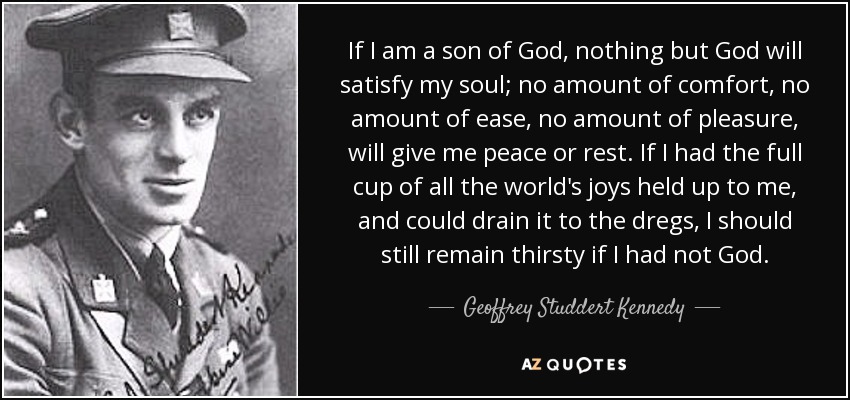
Geoffrey Studdert Kennedy was an English Anglican priest and poet. He was nicknamed Woodbine Willie during World War I . He had a practice where he offered a Woodbine cigarette along with spiritual aid to injured or dying soldiers.
He was a socialist Christian despite the disagreement between the respective organizations. He had converted to Christian socialism during the war. He wrote a number of books that were critical of capitalism.
He went on speaking tours for the Industrial Christian Fellowship in Britain. Das Kapital by Marx and Engels had been published in 1848, but the anti-capitalist ideas expressed in it had been made global with the rise of mechanized undustrialization and the First World War.
Christianity had been influenced with Marxist type ideas with the social gospel and political expressions of concern regarding economic inequality.
It's not as though there was nothing about which to complain, but Marxist ideology was Hegelian in the sense that there wasn't sincere acknowledgement of corrective action.
Anything accomplished in relation to capitalism was depicted as tainted by greed. There was no real way to correct the problem without forcing government to concede to the demands of labor or other factional representations of the public.
Zeal for the faith became an instrument for making the economic policy Messianic in character.
Socialists still have the tendency to look at the benefits of society as strictly a result of the on going criticism of capitalism as the cause of social malady.
My research into religion in the United States of America has evaluated the religious element of socialist statements. I have found that socialism is not consistent with Christianity or democracy in republic or kingdom.
Socialism subordinates the government to factional representation. The private sector isn't allowed to develop organization for the production of a product or service in the market due to the government control of the economy with taxes and commodity prices.
The life of Geoffrey Kennedy is only one example of a socialist who used Christianity to perpetuate his economic views.
Geoffrey Kennedy
b. 6.27.1883 Leeds, West Yorkshire, England
d. 3.8.1929 Liverpool, Merseyside, England
Geoffrey Kennedy was born in Leeds, England in 1883. He was the seventh of nine children born to Jeanette Anketell and William Studdert Kennedy, the vicar of St Mary's, Quarry Hill.
He was educated at Leeds Grammar School.
The name Leeds was derived from the old Brythonic word Ladenses meaning "people of the fast-flowing river" in reference to the River Aire that flows through the city. The name has also been explained as a derivative of Welsh lloed, meaning simply "a place".
Leeds developed as a market town in the Middle Ages as part of the local agricultural economy. It became a co-ordination center for the manufacture of woollen cloth and white broadcloth was traded at the White Cloth Hall before the Industrial Revolution.
A railway network was constructed around the city starting with the Leeds and Selby Railway in 1834. The network provided improved trade with travel and transportation to national markets.
An east-west connection with Manchester and the ports of Liverpool and Hull improved its development with access to global markets.
Manufacturing would diversify by 1914 to printing, engineering, chemicals and clothing manufacture.
Kennedy went to Trinity College in Dublin, Ireland for his degree in classics and divinity in 1904. He became a curate at St Andrew's Church, Rugby after a year's training at Ripon Clergy College. He became the vicar of St. Paul's in Worcester in 1914.
He volunteered as a chaplain to the army on the Western Front at the outbreak of World War I in the same year. He was awarded the Military Cross at Messines Ridge after running into no man's land to help the wounded during an attack on the German frontline in 1917.
He was given charge of St Edmund, King and Martyr in Lombard Street, London after the war. He wrote Lies (1919), Democracy and the Dog-Collar (1921), Food for the Fed Up (1921), The Wicket Gate (1923) and The Word and the Work (1925) to promote socialism and pacifism.
He went on speaking tours of Britain for the Industrial Christian Fellowship. He died in Liverpool on 8 March 1929 while he was on tour.
He was an enthusiast for the belief that socialism and Christianity were linked in the common cause of representation for labor. Labor was seen as the most significant faction of the public.
Democracy is damaged when a faction is represented as the only significant interest for the entire body. Even the Church as the body of Christ is not held to be the only significant representation in the democracy of republic or kingdom.
Adam Smith had included labor as part of the definition for the wealth of nations (Wealth of Nations, 1776). While his ideas had preceded those of Marx and Engels by about 3/4's of a century, his economic model was more beneficial for economic growth.
Geoffrey Kennedy
S. 杰弗里·肯尼迪
T. 杰弗裡·肯尼迪
杰 Jie Jay 杰 ketsu heroic Jie じぇ ジェ Je 제 my
弗 fu phew 弗 futsu dollar fu ふ フ peu 프 F
里 li inside 裡 ri reverse ri り- リ- li 리 Lee
肯 Ken Ken 肯 ko agreement Ke け ケ Ke 케 K
尼 ni nah 尼 ni nun ne ね ネ ne 네 yeah
迪 di Dee 迪 teki edify de でぃ ディ di 디 D
---------------------
The study of scripture became public after King James.
The influence of Calvin reduced it to a local political frame.
The growth of republic was limited by leftist media expression.
Anything functional was aggressively opposed to impose repression.
Marx and Engels blamed all wrong on capitalism
to imply that government control for labor worked for internationalism.
Religion was treated as a tool for conversion
in the interpretation of scripture for socialist subversion.
Some dedicated Christians were fooled by the device
The repetition of blame to eliminate opposition was a media vice.
The heroic effort to oppose the abuse of the power with money
proposed the overthrow of order for the madness of the bomber's monkey.
Messianic socialism proposed fanatic support for a false economic model
to force the case for logical semiotics in disagreement that is doctrinal.
===============
Lectionary: Geoffrey Studdert Kennedy
wiki GSK
GSK poems
Freedom is defined by thought.
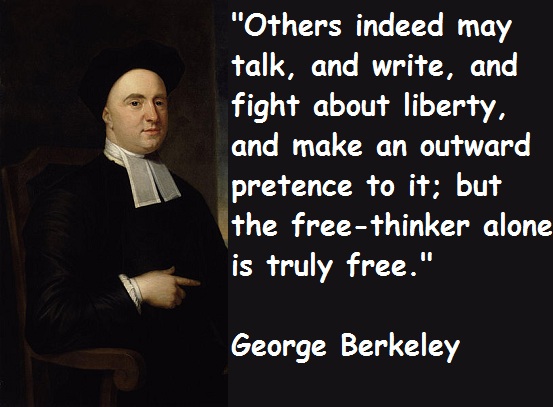
George Berkeley
Empiricism
The Fundamental Constitutions of Carolina were adopted on March 1, 1669 by the eight Lords Proprietors of the Province of Carolina. The land for the province was between what is now Virginia and Florida.
The documents were drafted during John Locke's service to one of Province of Carolina proprietors, Anthony Ashley Cooper. It is feasible that Locke had written much of them. This would make him a party to the institution of slavery in the area.
The Fundamental Constitutions promoted both aristocracy and slavery in North America. Article 110 of the Constitutions stated that "Every freeman of Carolina shall have absolute power and authority over his negro slaves, of what opinion or religion soever."
Pursuant to this provision slaveholders were granted absolute power of life and death over their slaves. The argument in the document held that being a Christian did not alter the civil dominion of a master over his slaves. (Article 107)
The Constitutions were adopted 20 years before the Essay Concerning Human Understanding and the Two Treatises of Government were published in 1689 and 1690. Insofar as all the works did not declare Locke as the author, the knowledge of his authorship was not knowledge that was published for the public.
Berkeley's position on slavery is known from his proposal to institute a missionary school in Bermuda that would train young black male slave to become educated as missionaries and responsible citizens prior to manumission. (1725)
The proposal was probably not accepted as it may have been perceived to be a justification for the institution of slavery.
The institution was not universally accepted. The royals had stated their opposition to it. The Whigs were instrumental in the documentation for it in the Constitutions of Carolina.
Slavery was instituted among the Greeks and the Romans. There was a strong association between it and the expansion of civilization with empire.
Opposition to it was expressed in the association of Cyrus and the liberation of the captives. Assyria had forbidden Israel from electing a king.
The Israelites did not have a kingdom to identify their nationality. They were dispersed or left to live among other people in the area. They came to be known as the ten lost tribes.
The problem that the classical world had with the institution then was a question of manumission. Some could win freedom as gladiators, but the slaves as captured or conquered were instituted as a class of people who could not become citizens.
It was an indefinite state that was justified at least in part by the Stoic philosophy that saw humanity as enslaved to the material condition.
Plato had expressed some agreement with the proposition. Aristotle had qualified his statement with a limited qualification. Some were meant to rule. Others were meant to be ruled.
Berkeley’s Principles of Human Knowledge (1710) was dedicated to disagreement with the abstraction that justified the perception of enslavement to matter.
While he explicitly opposed abstraction as a cause of error, he has been defined as unrealistic due to his idealism.
He asserted the reality of idea and spirit. Ideas are real because they are derived from that which can be perceived. Spirit is real because it can have ideas that others can perceive.
Ideas are derived from the mental perception of the physical qualities of objects, memory and imagination.
The existence of an idea depends on its being able to be perceived. An idea does not exist unless it is perceived.
Our substance was created by the mind of the Spirit in the sense that "esse est percipi" ("to be is to be perceived"). We are perceived by the mind of God.
The existenceof an idea cannot be separated from its being perceived. If an idea or object is not perceived, then it does not exist. All things are perceived by the all seeing eye.
The first important concept that Berkeley established was that existence has meaning in the perception of it. Things are only material because people are there to perceive them. Ideas are things that are perceived. Material things are perceived as ideas.
Things can exist outside of the perception of them in fact, but the knowledge of them does not exist with meaning until the objects are perceived and identified by the experience of the perceiver.
Berkeley sharply disagreed with the Essay of Human Understanding when it came to the perception of objects.
He agreed to the existence of general ideas
Locke had argued that abstract general ideas were necessary for convenience in communication and the enlargement of knowledge, but they are not necessary for communication or the enlargement of knowledge.
He described the abstract idea of a triangle as having all particular types, but no specifics (Principles of Human Knowledge, Introduction, s.13-15).
This wasn't true. The general definition of a triangle is that it is a closed figure with 3 sides and angles. This abstraction allows for any particular form.
Equilateral sides have angles of the same degree. One square angle allows for proportionate variance in the other two. Scalene triangles don't have sides or angles of equal size.
Knowledge of triangles has a strong association with classical culture. Some form of trigonometry has been used to build constructs for shelter or storage all the way back to ancient time Egypt.
Berkeley argued that we can't know any particular proposition to be true of all triangles unless there is a demonstration of the abstract which equally agrees to all. He stated that the existence of all abstract ideas was impossible. (Intro., s.21)
If Berkeley was an unreal idealist, it was because he denied the possibility of abstraction.
Locke was skewed in his understanding of triangles but he was right to assert that abstraction is convient to communication and the expansion of knowledge.
His leftist liberal abstraction however allowed for the indefinite institution of slavery in a way that included the establishment of a class of citizen that did not have the right to own private property or weapons.
The right to vote wasn't recognized, but their existence as part of the privately owned property would be used to justify the number of representatives in Congress.
Berkeley's disagreement with Locke was principled in intent if youthful in the particulars. His treatise was published in 1710, the first year of his ordination as a priest. His main intent was to identify freedom as an element in the design of the Creator of nature.
Objects of human knowledge are either ideas imprinted on the senses or are perceived by attending to the passions and operations of the mind.
The truth of statements becomes a matter for debate when ideas are compounded, divided or barely represent those things that were originally apprehended.
The ideas of light and color with several degrees and variants are seen by sight. Hardness, softness, heat, cold, motion, resistance or tangible qualities vary in quantity or degree according to the perception of touch.
Odor is sensed by smell. Taste is experienced by the palate. Variation in sound is conveyed to the mind by the reception of what is heard.
An apple is consistent with the color, shape, size, taste, hardness or qualities of the idea of it. Other collections of ideas constitute a stone, a tree, a book and the like in sensible things. They are pleasing or disagreeable insofar as feelings are invoked in the perception.
There is something which knows or perceives the objects of knowledge in the variety of ideas. Spirit is the context for mind. Soul is the experience of self.
Life lives within existence. It is not limited to the idea of it. The person retains a place in objectivity within the perception of existence.
-----------------------
Objects of knowledge exist in the variety of ideas.
The person transcends the perception of pieces in reason.
=================
wiki Fundamental Constitutions of Carolina
Philosophy Basics Berkeley
Principles for Human Knowledge text
------------------------
The Quantification of the Predicate

The predicate affirms something about the subject in a sentence.
Quantification indicates the measure of the qualification.
This is important in the domain of the conceivable with respect for the algebraic formulation of equations.
----------------------
Hamilton was an exponent of the Scottish common-sense philosophy developed by Thomas Reid. Reid had argued that common sense was the means to dispense with the problems created by the "skeptical views” of his predecessors: Descartes, Locke, Berkeley and Hume.
His contribution to logic was the theory of the quantification of the predicate. He became the forerunner of the present algebraic school of logicians by the importance of this consideration.
Sir William Hamilton
b. 3.8.1788 Glasgow, Scotland
d. 5.6.1856 Edinburgh, Scotland
William was born into the University of Glasgow. His father was Professor William Hamilton. He had been appointed to succeed his own father, Dr. Thomas Hamilton, as Regius Professor of Anatomy in 1781. The young professor died in 1790 at the age of 32 having already gained a reputation.
William and his brother Thomas were raised by their mother, Elizabeth Stirling. This person is occassonally distinguished from others of the same name by the addition of his mother's maiden name, William Stirling Hamilton.
He received his early education at Glasgow Grammar School except for 2 years at a private school in Chiswick in Kent. He went to Balliol College, Oxford in 1807. He obtained a first class in literis humanioribus. He took his BA in 1811 and his MA in 1814.
He had intended to enter the medical profession, but gave up the idea after leaving Oxford. He became a member of the Scottish bar as a qualified advocate in 1813. He developed a philosophical system with continued investigation.
His investigation enabled him to claim representation for the ancient family of Hamilton of Preston as a baronet in 1816. The family claim had been in abeyance since the death of Sir Robert Hamilton of Preston (1650-1701).
He visited Germany in 1817 and 1820. He learned German and used it to study German philosophy.
He was a candidate for the chair of moral philosophy in the University of Edinburgh, but was defeatedin 1820.
He was appointed the professor of civil history in 1821. He delivered several courses of lectures on the history of modern Europe and literature. He gave up the position when the salary ceased.
His mother died in 1827. He married Janet Marshall, his cousin, in 1828. They moved into a townhouse at 11 Manor Place, in Edinburgh's west end.
His career of authorship began with the appearance of the well-known essay on the "Philosophy of the Unconditioned" in 1829.
The conceivable in thought lies between two extremes. When the extremes are contradictory both can not be true. Only one must be true when it is properly conceived. That the conceivable is in every relation bounded by the inconceivable was called the law of the conditioned.
Infinity fell into the category of the inconceivable and incognizable. It was the affirmation of impossibility in knowing Absolute Being. Kant had made a priori elements forms of the mind.
The ideas of self, the universe and God became regulative of intellectual procedure with no guarantee of proof in truth. Certain dogmatic cognitions eluded judgment. That the world had a beginning or not could not be decided on superiority in conception.
That every composite substance consists of simple parts was contradicted by the assertion that no composite thing consists of simple parts.
That the causality according to the laws of nature was not the only causality in the origination of the world was contradicted by the claim that there is no other causality.
The argument that there is an absolute necessary being was countered by the claim that this is not any such being.
Hamilton maintained that such contradictions are not the product of reason. They result from the attempt to push reason beyond its proper limits. The conceivable is the realm of the relative and bounded. The 'antinomies' came from the effort to use reason outside of its own province.
Conceivable conceptions can be measured for importance in our existence. Infinity itself cannot be measured, but the formulations of the infinite can be calculated.
He was elected in 1836 to the University of Edinburgh chair of logic and metaphysics. He exerted an influence on the thought of the younger generation in Scotland for the next 20 years.
He published an annotated edition of the works of Thomas Reid in 1846. He prepared extensive material for publication on the personal history, influence and opinions of Martin Luther, but it still remains in manuscript.
The first and second editions of his Discussions in Philosophy, Literature and Education appeared in the Edinburgh Review between 1852 and 1853.
He taught his class for the last time in the winter of 1855–1856. Shortly after the close of the session he was taken ill and died. He was buried in St John's Episcopal Churchyard at the east end of Princes Street in Edinburgh.
Hamilton's contribution to the progress of thought stimulated a spirit of criticism in his pupils by insisting on the great importance of psychology as opposed to the older metaphysical method. His criticism of the thought of Immanuel Kant was noteworthy.
William Hamilton
S. 威廉·汉密尔顿
T. 威廉·漢密爾頓
威 Wei prestige 威 i dignity Ui うぃ ウィ Wil 윌 Will
廉 lian inexpensive 廉 ren bargain ri り リ li 리 Lee
汉 Han Chinese 漢 kan Sino- a あ ア eom 엄 moth
密 mi dense 密 mitsu secrecy mu む ム Hae 해 year
尔 er er 爾 ji you Ha は ハ mil 밀 wheat
顿 dun pause 頓 ton suddenly mi み ミ teon 턴 turn
ru る ル
ton とん トン
---------------------
Measure can be made within the conceivable.
The quantification of a predicate makes a statement believable.
The foundation for morality is a treasure
when reason is not overextended as a clever pleasure.
===============
wiki Sir William Hamilton 9th Baronet
IEP: William Hamilton
-----------------------
Balanced Budget Amendment
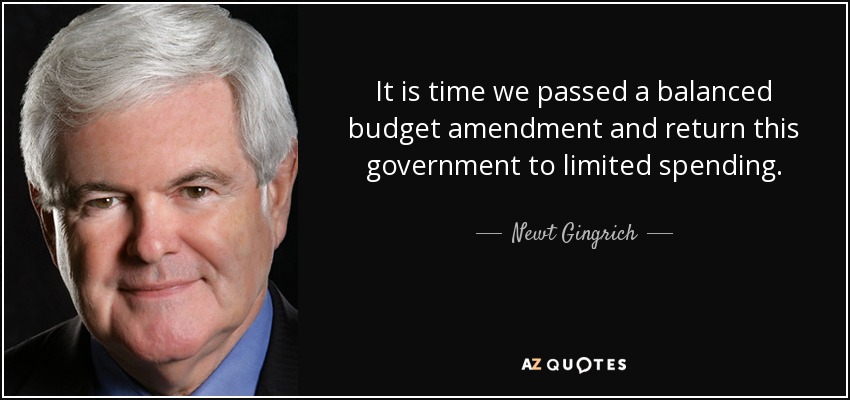
The amendment proposes that the US Constitution bar the government from spending more than it brings in in federal revenue.
Pros and Cons
Budget Basics
"Supporters of a balanced budget amendment argue that respect for the Constitution will create strong political pressure to rein in deficits and impose needed accountability for irresponsible fiscal policy...
"Opponents argue that the political pressure could lead to budget gimmicks that would meet the letter, but not the spirit, of the law."
Argument Against
VOX Trump Ryan Tax
The amendment has failed "in 1982, and again in 1986, and in 1995, and so on. The last time Congress voted on a balanced budget amendment was in 2011."
"“Their real goal is to end Medicare, Medicaid, and Social Security as we know it,” Minority Leader Nancy Pelosi said."
Hannity and Gingrich 2012
Balanced Budget Amendment Interview
If the income tax is 10% or higher and the social security tax is 10% or higher, the total tax is 20% or higher. That's a large amount of money that goes into government operations.
A number cruncher could look at the number of employees that pay 20% or more of their paycheck to calculate the total revenue derived from employee income.
How many mass media stories about war or defense against the threat of attack are concerned with a balanced budget?
If the goal is to defend government expenditure in a way that includes support for national security with the military, covert agency, border security and the protection of trade relations, then at least some government officials are going to adopt a position that always pushes for stories about the need to increase expenditure.
How trustworthy are government officials who claim that social security actually goes into Medicare, Medicaid, food stamps or Supplemental Security Income? Dependency on politically motivated candidacy is subject to deception in communication.
When unscrupulous officials report that they spend more on the people than they actually do, they could conceivably take the remainder to pay for media stories, campaigns for re-election and unconstitutional surveillance.
The balanced budget amendment will reduce the capacity for dishonesty in official reports to the public.


